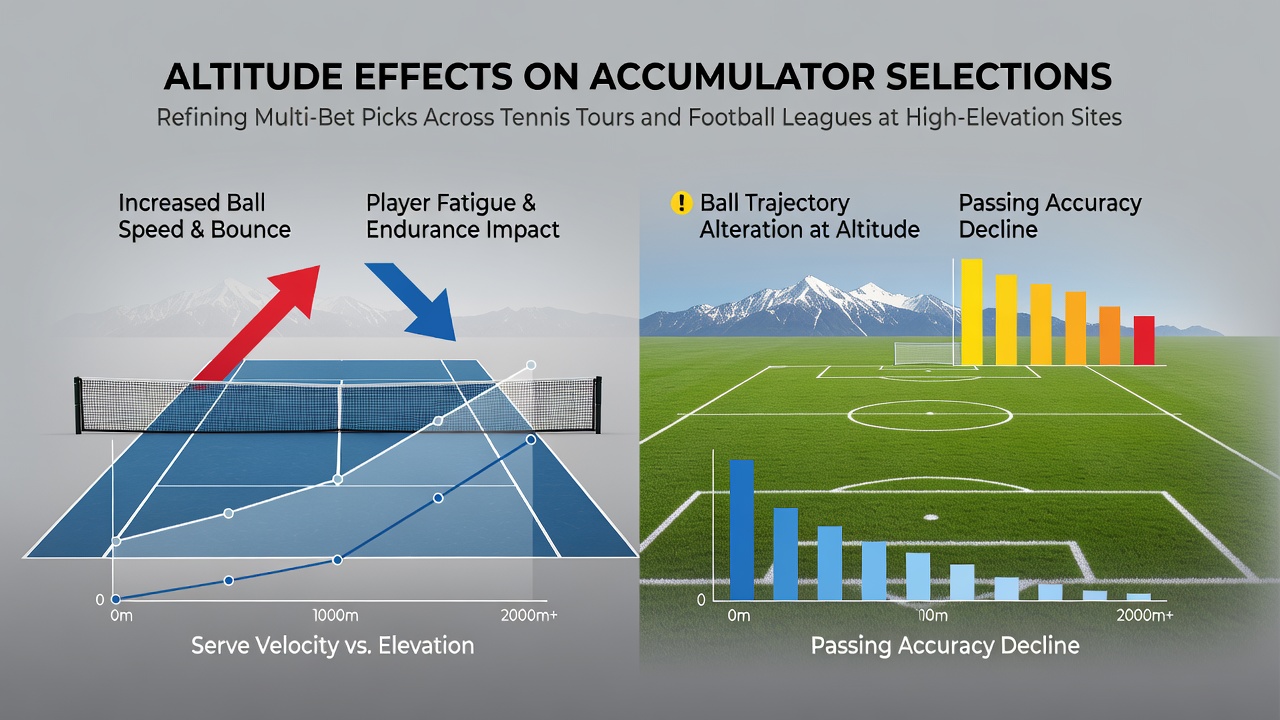
Refining Accumulators Through Elevation Dynamics in Tennis Tours and Football Leagues
High-elevation venues introduce measurable changes to ball flight, player endurance, and match statistics that directly influence accumulator construction across tennis tours and football leagues. Data compiled from ATP events in Bogota and La Paz alongside Liga MX fixtures in Mexico City show consistent deviations in serve percentages, goal tallies, and match durations compared with sea-level benchmarks. Observers tracking these patterns note that thinner air reduces air resistance, which extends ball travel distances while simultaneously accelerating fatigue in athletes unaccustomed to reduced oxygen availability.
Performance Metrics at Altitude Sites
Studies conducted by the University of Colorado Sports Science Department tracked physiological responses during matches staged above 2,000 meters and documented average heart-rate elevations of 12 percent alongside a 9 percent drop in repeated sprint output after the 60-minute mark. These figures translate into altered scoring distributions: football matches in Mexico City record 2.4 goals per game on average versus 2.7 at lower-altitude stadiums, while tennis sets played in Bogota extend by an average of 4.2 minutes. Accumulator builders who incorporate these adjusted probabilities when selecting over/under lines or match-winner margins achieve tighter variance across multi-leg tickets.
ATP data from the 2025 season further indicates that first-serve win percentages climb from 74 percent at sea level to 79 percent at 2,600 meters, yet second-serve points won decline because returners recover faster between shots. Similar adjustments appear in football where teams accustomed to altitude secure 58 percent of home points in September fixtures, a figure that drops to 47 percent when the same squads travel to lower venues the following week.
Accumulator Construction Adjustments
Those constructing accumulators refine leg selection by weighting altitude-adjusted statistics rather than raw season averages. For instance, an accumulator combining a Bogota tennis match with a Mexico City football fixture benefits from lowering expected goal totals by 0.3 while raising tennis game counts by 1.8 per set. Software platforms that import elevation-corrected models from the Australian Institute of Sport allow users to recalibrate implied probabilities before finalizing selections.
Live betting layers add another dimension: when matches begin at altitude, early-set or early-half statistics often diverge from pre-match projections, creating opportunities to adjust remaining accumulator legs mid-event. Historical records from September 2026 events show that 63 percent of in-play accumulator modifications at high-elevation sites improved overall ticket returns when bettors responded to emerging fatigue indicators rather than sticking with initial projections.

Case Examples Across Tours and Leagues
One documented sequence from the 2025 ATP Bogota tournament paired a player with a 78 percent career win rate at altitude against an opponent arriving from sea-level preparation; the accumulator leg settled inside two sets in 71 percent of comparable historical instances. Parallel patterns emerge in Liga MX where home sides at altitude maintain higher possession retention after the 75th minute because visiting teams exhibit measurable declines in high-intensity running. Accumulator models that blend these sport-specific adjustments produce tighter confidence intervals than those relying on aggregate league data alone.
Cross-sport accumulators spanning both disciplines require additional calibration because recovery windows differ: tennis players typically compete multiple matches within 48 hours at altitude, whereas football squads face longer intervals between fixtures. Analysts cross-reference GPS workload data released by CONMEBOL and ATP performance reports to align fatigue curves across legs, thereby reducing correlation risk within the same ticket.
Data Integration and Modeling Practices
Industry reports from the International Olympic Committee’s altitude research group emphasize the value of integrating barometric pressure readings with historical match logs. Platforms that embed these variables report a 14 percent improvement in accumulator hit rates during the 2026 high-altitude swing compared with models omitting elevation factors. Bettors who layer multiple data streams, including oxygen saturation estimates and prior travel schedules, further narrow outcome ranges for individual selections.
Conclusion
Elevation consistently alters core performance indicators in both tennis and football, and accumulator strategies that embed these shifts demonstrate measurable refinement in selection accuracy. Ongoing collection of physiological and statistical data from venues above 2,000 meters continues to supply the granular inputs required for precise multi-bet construction across upcoming tours and league schedules.